Why I Hate Horror But Love Halloween, a Guest Post by Jennifer from Girls Gone Reading

So far, all the Fright Fest guest posts have been from people who love the thriller/horror genres.  This post is different. Today’s guest poster is Jennifer from Girls Gone Reading. As you will see in her post, she hates horror, detests being scared.  But not to worry; there is hope!

Why I Hate Horror But Love Halloween

Everyone likes to get a little scared, right? Wrong. I hate it. I have hated horror since fifth grade slumber parties when Freddy Krueger tried to attack me in my dreams. I would “watch” Nightmare on Elm Street by focusing anywhere by the screen. Instead, I would stare at a spot just above the television-fooling all my best friends. I would shudder when they shuddered. Scream when they screamed. It was fool proof until the inevitable happened. Occasionally my eyes, filled with curiosity, would drift down the screen. Then there he would be, Freddy in all his glory: slimy, disfigured, clawed. My eyes would instantly slam shut with nightmares right around the corner.

My problem with horror has continued for the rest of my life. The Blair Witch Project made me think ghosts were real and in the woods. This was especially great because my parents live in the woods, the movie came out in the summer, and mis padres wouldn’t turn the air on. Every time the wind blew it was a reminder of a ghost coming to attack. And don’t even get me started about what Stephen King did to clowns and creepy parks.

Nothing about horror appeals to me. Nothing. Nothing that is except Halloween. I love Halloween not because it is scary. I love it because once you remove all the scary elements from the holiday Halloween allows you to be, to live as someone else. Halloween is a real life way to try on something new. To be something else. Reading, of course, does this for me the rest of the year, but I don’t usually read books in full costume and get to speak in accents. Halloween brings out the actress in me. Instead of scaring my friends, I make them admire my Brittney Spears imitation. Or at least I pretend they are impressed.

Being someone else might be scary, but for me it is liberating. I want to live lots of lives, but unfortunately I get just the one. I don’t want to be scared, but I do want to be adventurous. I do want to try something new. Halloween is the only holiday where I still get to play the part, and I love every minute of it.

One problem recently occurred to me though: Am I avoiding a lot of the fun life has to offer by doing nothing scary? Am I living life fully if I never get scared just for fun? I plan to change that this Halloween, with your help of course. As part of my twelve step rehabilitation into all things scary, this Halloween I am going to attempt to go back into the world of horror. I will read one horror book the week of Halloween. The only problem is I don’t know what to read. Got any suggestions?

To further aid my rehab program I will also go to one haunted house. Yes, I will pay people money to scare me in my own bed while I read, and I will also spend some cold cash to have strangers chase/scream/jump at me in the woods. Sounds horrible, right? Well what would good Halloween be, the best holiday of the year, without trying something new?

Posted in Fright Fest | Tagged , , | 5 Comments

Guest Post: Can Handwriting Reveal a Serial Killer?

There’s nothing scarier that a real-life monster, a serial killer.  Today’s guest post comes from Sheila Lowe, a forensic handwriting expert with more forty years of experience in the field. She holds a Bachelor of Science degree in psychology and is the author of several published books including Handwriting of the Famous & Infamous, and The Complete Idiot’s Guide to Handwriting Analysis, as well as Sheila Lowe’s Handwriting Analyzer software. Her first mystery novel, Poison Pen, received a starred review in Publishers Weekly and introduces forensic handwriting expert, Claudia Rose, who uses her handwriting analysis skills to help solve crimes. Today Sheila is going to examine the handwriting of serial killers and detail just what their handwriting says about them.

Can Handwriting Reveal a Serial Killer?

He was handsome, charismatic, captivating. He was convicted of the rape and murder of ten women in Florida. He’d probably raped at least fifty.

As with other violent crimes, serial murder is on the increase. Between 1900-1950, an average of 1.2 cases a year were recorded. In 1960 there were 12 cases. By the 1980s this offense had jumped to an average of two cases a month. Since 1977 more than two hundred serial killers have been convicted, with well over a thousand victims between them. More than 80% of all serial murders have occurred in less than 30 years.

Like others of his ilk, serial murderer Robert Joseph Long managed to elude capture over a lengthy period–how? Because he was able to look and act pretty much like the average guy. He knew how to fit into society and appear like the rest of us. But his handwriting held clues that pointed to pathological behavior.

Most people agree that the way a person walks says a lot about him. Someone who swaggers into a room, for example, has a very different personality from one who diffidently creeps along, hugging the wall. Researchers tell us that facial expressions are interpreted the same way the world over, and one’s tone of voice indicates his mood. Similarly, handwriting is a projective behavior akin to body language, tone of voice, and facial expression, and it reveals a important information about motivation and personality, the good, the bad, and the ugly.

Having said that, let me be very clear that there is no such thing as a “criminal handwriting.” In an attempt to identify patterns of similarity in the handwritings of serial killers, I examined the handwritings of a number of notorious murderers. What I discovered was, there was no direct “this-means-that” correlation of a personality trait to a handwriting characteristic; it was far more subtle than that.

It would have been handy if we could neatly package up a syndrome of traits and instantly identify a serial killer or any other type of criminal, but what actually manifests in handwriting are red flags for certain types of pathological behavior, or the potential for it. Because what we see written on a sheet of paper is like a photograph of the past, the handwriting professional can make some extrapolations, but cannot absolutely predict future behavior.

With the exception of Wesley Allan Dodd, the handwritings available for my examination were written after incarceration, when these men and women were forced to toe the mark and curb their deadly appetites. The restraint they had to practice–the need to follow strict prison rules–had an effect on their handwriting, making it appear far more rigid and controlled than in the time leading up to a kill, when their murderous rage was building to a breaking point.

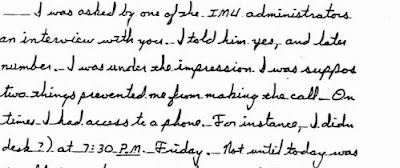
Robert Joseph Long, mentioned in the introduction to this article, has been described as “shockingly brutal.” He beat, raped, and strangled his victims. Long’s handwriting is rigid to an extreme, seen in the tight, angular forms, which indicates a lack of emotional release. Positive emotional release would be seen in a balance of rounded and angular forms. Note the extremely long t-crosses. This straight horizontal movement, combined with the rigidity, reveals his need to dominate and control others.
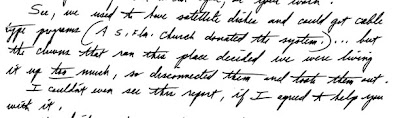


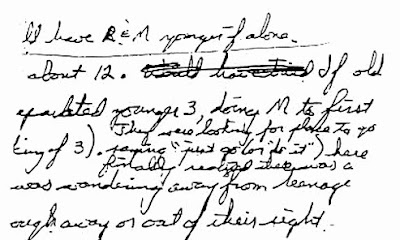
Wesley Allan Dodd, executed at his own request by hanging in 1993, kept a diary during the time he was killing little boys. His handwriting during the time leading up to a killing is far more “released” (though not in a positive way) and expansive than the second sample, written after he was convicted. You don’t have to be a handwriting expert to see the difference in the two samples. The second one is reminiscent of Bob Long’s, highly controlled and rigid, while the first is out of control.


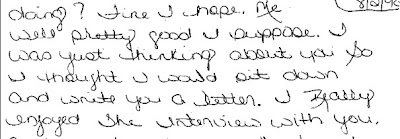
Serial murder is not confined to male perpetrators. Aileen Wuornos, the subject of the movie, Monster, was executed in 2002 for the deaths of seven men. Christine Slaughter Falling (talk about an appropriate name!), whose handwriting appears below, is a very different personality type, but just as deadly. She was accused of killing at least six infants and toddlers she babysat, and was convicted of three counts of murder in 1982, receiving a life sentence that made her eligible for parole in 25 years. In an interview for CNN in 1992, Falling was asked what she would do if released. Her answer: she would like to babysit again, because, “I love kids to death.” She was denied parole in 2006.

Her handwriting sample, written after 10 years of incarceration, is the polar opposite of Dodd’s and Long’s. The extreme roundedness of the writing and the large size, suggest an egocentric person who was constantly seeking love and approval (though clearly, not in healthy ways). The letters “M” on “Me” and “R” on “really” are made in such a way that they look like an X. Such forms are often made by people with a death consciousness, sometimes by one who has experienced a death close to them, or perhaps have received a serious diagnosis of physical illness. In Falling’s case, perhaps her responsibility for the deaths of several young children was on her mind–though not her conscience. This handwriting specimen wasn’t made by someone with a conscience.

Another fairly rare characteristic in Falling’s handwriting is seen in some of the upper loops, such as the “l” on “letter,” which are made in the shape of a candle flame. The flame-shaped upper loop is often seen in one who has sustained a blow to the head. It’s known that when Christine was 8 years old, her mother (who was a 16 year-old-prostitute when Christine was born), hit her in the head with a two-by-four, after which she began having seizures. These flame-shaped loops are often created by those who tend to see the world quite differently than most of us do.
Most, if not all, serial killers came from childhoods where they were abused and/or neglected. Yet, comparatively few abused children grow up to be killers or engage in other types of crime. Many factors, both nature and nurture come into play. Genetics, environment, and the individual’s personal responses to a variety of experiences blend together to determine the outcome.

Handwriting, like personality, is made up of thousands of variables. In order to make any kind of objective assessment, it is important to study the whole picture, not just bits and pieces. The characteristics described above were viewed within the context of larger samples of writing, and are intended only as an teaser to what kinds of information is revealed. Handwriting cannot tell everything about the writer, but it can open a window into the mind, both of the criminal and the “normal” person. Some psychologists find it helps them to get a rapid grasp on what makes a person tick–whether the writer is motivated by the need for power, the need for security, the need to be loved, etc. Especially when used in conjunction with other personality assessment instruments, handwriting analysis can be an important tool for understanding the human psyche.

(Originally published on The Graveyard Shift.  Republished at the permission of the author.)
Posted in Fright Fest | Tagged , , | 9 Comments

Review: The Familiars by Adam Jay Epstein & Andrew Jacobson

  • Reading level: Ages 9-12
  • Hardcover: 368 pages
  • Publisher: HarperCollins; 1st edition (September 7, 2010)
  • ISBN-10: 0061961086
  • Source: Publisher

Aldwyn is a rough & tough alley cat on the run from a bounty hunter.  He’s able to sneak into a shop and avoids capture.  Aldwyn finds himself surrounded by animals of all shapes, sizes, & colors.  They aren’t your standard pet store animals, however.  They are familiars-animal companions of witches & wizards-and within moments Aldwyn is mistaken for one and adopted by a young boy

When he arrives at his new home, Aldwyn is introduced to the other familiars in the home: Skylar, a blue jay, a bit arrogant about her abilities and Gilbert, a red-eye tree frog who spends most of his time obsessing about when he’s going to eat next.  Fearful for blowing his cover, Aldwyn tells the others that he has telekinetic & mind-reading powers.

Just as he starts to get settled into his new home, Aldwyn’s “loyal” Jack, his sister, and another student are kidnapped. Aldwyn, Skylar, & Gilbert are the only ones who can save them. Throughout the journey, Aldwyn learns a great deal about the others, and himself. It turns out he might be a little more than the “average” alley cat!

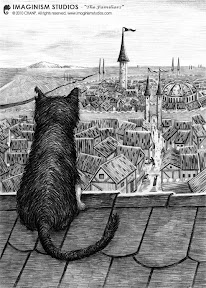
I read THE FAMILIARS aloud to both of my boys.  Despite their six-year age difference, both boys thoroughly enjoyed this book. We’re a house full of Harry Potter, Percy Jackson, etc. so it wasn’t a surprise.  We all fell in love with the familiars (it doesn’t hurt that our cat, Sylvester, is the spitting image of Aldwyn).  They enjoyed the fast-paced excitement; there really is never a dull moment in this book. The art by Peter Chan & Kei Acedera really enhanced the reading experience as well.  My youngest is 5, so sometimes it takes a few pictures to keep him engaged. Here are just a few samples of the art:


Considering this is a book written jointly by two authors, I assumed the writing would be disjointed or unorganized.  Far from it!  It’s seamless, impossible to tell the difference in the writers’ voices.  I’m excited to see that Adam & Andrew plan to continue this series and a move is in the works as well.  Highly recommended!

Don’t forget to check out yesterday’s post about the Familiars Halloween Scavenger Hunt!

Posted in 7-10 years of age, 8-12 years of age, Harper Collins Publishers, Kid-Lit/Middle Grade, Review | Tagged , , , , , , | 4 Comments

The Familiars Halloween Scavenger Hunt!

I’m super excited to be participating in The Familiars Halloween blog tour! Today’s post includes a special tour of haunted Hollywood by Andrew Jacobson, one of the co-authors of THE FAMILIARS!

My review will post tomorrow, but I wanted to kick it off with a special Familiars-themed Halloween Scavenger Hunt! At each stop along the blog tour, we will be asking a trivia question from our book. After you fill in your answer, the letter that falls in the place of the * can be placed in the corresponding number of the larger puzzle. So for example, since this is question number 4, the letter that lands in the space where the * is can be filled in where the 4 is in the larger puzzle. The larger puzzle will form yet another clue, and anyone who answers it correctly will be entered into a drawing for an autographed book as well as a few other Halloween treats!

Be sure to visit The Familiars blog at thefamiliars.blogspot.com to find links to all other blog stops and find out where to send in your answers! All entries must be entered by November 15.

4. A simple, but powerful spell created by the great forest communer Horteus Ebekenezer. 
___ ___ ___ ___ ___ ___  ___       ___ ___ _*_ ___ ___ ___ ___
Hint:  Chapter One, Page 2
11    5    18    8    15    1       9            7    19    14    23    2    25    16    10    12    20
__  __  __  __  __  __  ‘  __        __  __  __   __   __   __   __   __   __   __
17    3    22    6          21     4   24   13
__  __  __   __       __  __  __  __

www.thefamiliars.com (official website)
http://www.youtube.com/watch?v=b0djEE4OzdQ (book trailer)
Happy Halloween everyone!
Andrew & Adam

Be sure to come back tomorrow for my review of THE FAMILIARS!

Posted in Fright Fest, Kid-Lit/Middle Grade | 1 Comment

Guest Post: Mary Sharatt, Author of Daughters of the Witching Hill

I’m excited to welcome Mary Sharatt, author of  Daughters of the Witching Hill, back for a special Halloween guest post.  You may recall, I reviewed her book back in April   and was pleased when she expressed an interested in participating in Fright Fest. 

Killing a Witch: Magical Warfare in 19th Century Lancashire by Mary Sharratt

Modern Halloween celebrations, with their cartoon witches on broomsticks, belie the fact that our not-so-distant ancestors believed that magic was real, and not always in a good way. People lived in dread of vast teeming invisible forces threatening their very existence and they were all too willing to blame their misfortunes on supposed witches.

My adopted home of Lancashire, England is still haunted by the legacy of the infamous Pendle Witch Trials of 1612 and the lesser known trials of 1633, which bore witness to untold suffering of the accused. But even after Edmund Robinson, the ten-year-old boy whose accusations triggered the 1633 arrests, revealed his story to be perjury, the belief in witchcraft continued. “No part of England hath so many witches,” Edward Fleetwood stated in his 1645 pamphlet.

These superstitions endured well into the 19th century. John Harland and T.T. Wilkinson’s book Lancashire Folklore, published in 1867, tells the tale of an elderly man, a devout Methodist and also a cunning man who practiced counter-magic to defeat witchcraft.

The cunning man and his neighboring farmers discovered that their cattle were diseased and going mad. Their cream soured in the churn, and the butter wouldn’t come. Horses appeared bewitched and hag-ridden, and sheep were unproductive. The horseshoes, rowan switches, and holed stones hung in the barns to ward against witchcraft had lost their power. They concluded that some great malevolence must be at work.

Their suspicions rested upon an old man, a noted astrologer and fortune-teller known as the Wizard of Rossendale.

Thus our cunning man set out to defeat the wizard by performing the chilling ceremony known as “killing a witch.”

One cold November evening, when the moors and valleys were shrouded in fog, the cunning man gathered with the afflicted farmers. Having procured a live rooster, they stuck it full of pins and burned it alive, whilst chanting incantations. A cake was made of oats mixed with the urine of those bewitched, and, after having marked the cake with the name of the Wizard of Rossendale, it was burned along with the poor cockerel.

The wind rose in a tempest, as though threatening to destroy the house. Dreadful moaning could be heard outside, as though someone out in the storm were in the throes of unspeakable torment. When the storm was at its wildest, they heard the supposed wizard knock upon the door and beg to be allowed in. But the cunning man had warned them that if they took pity and opened the door, letting the wizard in, the virtue of this spell would be removed. So they hardened their hearts to the wizard’s pleas, leaving the man to die in the storm. According to the story, the Rossendale Wizard’s lifeless body was discovered in the morning and so ended his evil enchantment on cattle and herd.

I wonder what truth lies behind this tale. Did the old astrologer really die? He might well have perished of the shame and blame after everyone his community turned against him. Surely the real forces of darkness and evil lay in the ignorance that moved people to persecute their neighbors.

Mary Sharratt is an American writer living in the Pendle region of Northern England. Her latest novel, Daughters of the Witching Hill (Houghton Mifflin Harcourt) tells the true and heartbreaking story of the Pendle Witches of 1612. She is currently at work on a new novel exploring the life of visionary abbess and polymath, Hildegard von Bingen. Visit Mary’s website: www.marysharratt.com and watch her video docudrama about the Pendle Witches here:

Posted in Fright Fest | Tagged , , | 2 Comments

Guest Movie Review: The Haunting

Today’s guest review comes from Pamela K. Kinney, published author of mainly horror, fantasy and science fiction short stories.  She also has two nonfiction books about ghost stories in Richmond, Virginia and its surrounding counties, called Haunted Richmond, Virginia and also Haunted Virginia: Legends, Myths and True Tales from Schiffer Books (www.schifferbooks.com).

Review of The Haunting (1963)

“You may not believe in ghosts but you cannot deny terror.
SCREAM…no one will hear you! RUN…and the silent footsteps will follow, for in Hill House the dead are restless!” –blurb for The Haunting.

With films like Paranormal Activity and other modern ghost story movies that have been released in the past few years, all of them with special effects done by computer and more, it’s hard to imagine anyone being frightened by a black and white film that first came out in movie theaters in 1963. But that’s what this movie did back then, and still does—scares the bejesus out of you. Based on the horror novel, The Haunting of Hill House by Shirley Jackson, this book was the only one to scare me during the day time, in a room full of people. The movie is very exact to the book, bringing the fear with it, too.

Director Robert Wise brings to us a black and white film that doesn’t need color to scare us with a good old-fashioned ghost story. He draws on our fears and lets the movie master them well.

There are people picked out by Dr. Markway, all with some psychic abilities currently or in their past. Most of those he contacts bows out when they check up on Hill House and its past, except for two women, Eleanor “Nell” Lance, played by Julie Harris and Theodora “Theo”, played by Claire Bloom. Russ Tamblyn acts out the character, Luke Sanderson, who is not psychic. His mother owns Hill House and he is looking forward to the day when he inherits it and make a lot of money from its sale. A skeptic about the house, his stay there will begin to show him differently. The character of Dr. Markway is played quite ably by Richard Johnson. Dr. John Markway is a man who chose anthropology and parapsychology for his field because he felt it was the closest respectable academic discipline to the study of ghosts or “supernatural manifestations. Discovering Hill House with it’s frightening past proved to be a gold mine for him in his research.

The character Nell is a lonely woman looking for her place in the world after caring for her ailing invalid mother for eleven years. When she was a teenager, her paranormal experience was poltergeist activity. Teenagers are blamed for poltergeists most of the time. With her repressed years with her mother and not long after living with her sister and her sister’s family, watching the film again, this time on the big screen, I suspect a lot of what happens in the house can be attributed to her. Nell is insecure and with a supernatural past. As the film progresses, she becomes increasingly withdrawn from reality, and her fate, though sad, is exactly what she wants. Reviewers in the past have complained about her lost waif becoming annoying and yes, she can be and maybe there’s not much sympathy for her fate when it happens, but still, I think this made her character understandable in why the house possessed her most of all.

Theo is clairvoyant, mysterious and even seductive. Julie Harris, a five-time Tony-award winning actress, ultimately paints a sympathetic picture of a homely woman.

But the central character, the house itself, is the star of this film. It comes alive and begins to play with all of them in terrifying ways. The ghosts are never seen, but yet, things happen. Is it phantoms, the house, or even the mortals locked in the house together? You are drawn subtly into the relationship that grows between it and Nell. Is the house working on her, or is she working on the house with her own growing madness?

And that is what makes The Haunting work. No special effects but you are drawn into the story. Things build and build until you have to scream when something does happen. Don’t open that door! Let whatever is pounding, keep pounding. Until the last moments, like those in Hill House, you can not escape.

Rent the DVD or buy it, pop some popcorn and get comfortable, or if you have the chance like I did to see it on the big screen, do so, and be prepared to be scared.

“An evil old house, the kind some people call haunted, is like an undiscovered country waiting to be explored. Hill House had stood for 90 years and might stand for 90 more. Silence lay steadily against the wood and stone of Hill House, and whatever walked there… walked alone.” –“The Haunting.”

Posted in Fright Fest | Tagged , , | 1 Comment

The Definition of Horror Fiction

This is a question I get asked quite often…what makes a book horror, versus let’s say thrillers or suspense?  Admittedly, it is quite confusing to discern the differences.  To me, horror is any piece of writing that causes the reader to experience a sense of dread or fear.  Horror forces us to realize and confront our fears.  In many cases, as I’ve stated repeatedly, horror forces us to examine social issues that are often ignored or frowned upon. Notice I didn’t state that said writing must contain vampires, ghosts, werewolves, or anything supernatural? There are many ways in which this fear is elicited, including unnatural things like monsters or ghosts, but realistic situations, including mass murderers, serial killers, etc. can be used. Part of the way this fear is created is through the setting and atmosphere.  Picture a dark, abandoned house, full of spider-webs, shadows, creaking with age. This setting quite easily evokes fear and dread, right? With horror movies, the chilling background music adds to the atmosphere as well.

Classic examples of what could be termed horror fiction include Dracula, Frankenstein and The Picture of Dorian Gray. Modern horror would include the likes of Stephen King and books such as The Strain and The Passage.

I’ve been a fan of horror for nearly 20 years.  Throughout this time, I’ve noticed that horror gets a bad rap from readers or other writers.  Why is this?

In the late 70s and early 80s, horror fiction was quite popular.  We can thank Stephen King for that. All sorts of other horror authors came out of the woodwork but instead of creating a strong, established genre, horror lost its identity.  So many books falling under the horror genre were published and it became hard to describe exactly what horror was. Then in the early 90s, the public’s view of horror changed. It was no longer good for writers to be labeled as horror authors. Instead, their books were published under other genres, including thriller, speculative fiction or science fiction. Somehow, in this time-frame, the term “horror fiction” became a bad label.  

It’s a shame, really.  The point of Fright Fest was to show there is some really quality “horror” fiction out there.  It isn’t just blood and gore and chainsaws and violence. If you look hard enough, you can find some pretty outstanding writing hidden under all that gore, and frankly,  hidden within the gore.

Posted in Fright Fest | Tagged | 8 Comments

Guest Post: What Makes a Thriller?

Earlier in the month, I was chatting on Twitter (of course!) about the differences between thrillers & horror.  I was interested in writing a post discerning the two, and Carrie (also known as @inkedhistorian on Twitter. willingly obliged.  Carrie blogs about books at The Books I Read.  Here’s a bit about Carrie:

Speculative fiction writer, art historian specializing in early American books and prints, and amiable raconteur.Reads, cooks, takes pictures and gets tattoos in her spare time.Married to a mad scientist, mother to a rock star.

What Makes A Thriller?

To describe a story or novel as being a thriller means to relegate it to a category of writing that is overwhelmed with expectation. A “good” thriller meets these expectations, while a “bad” thriller does not. Somewhere near the beginning, we need to be introduced to a main character who will be our avatar for the story. For the purposes of this example, we’ll pick an accountant from upstate New York, and we’ll call him Jack. Jack will live through the whole story, and possibly even through the ending, though that remains to be seen. It will be Jack’s story that we’re reading, and Jack who we identify with. In caring about Jack, in eventually fearing for his safety, we will expose those emotions in our own chests, and the book will rub them raw.

Which is the point of reading a thriller, anyway.

But let’s get back to Jack. Perhaps we meet him at the funeral for his wife, or a friend, or the family dog. Perhaps he’s been fired under mysterious circumstances, or his car’s tires have been slashed. These events, when they happen in the first chapter of the book, tell us that something bad is already after Jack, and gives us insight into his predicament that he himself probably doesn’t have yet. Depending on the author, the bad thing hiding in the shadows of Jack’s life hasn’t noticed him when the tale begins. We might get to see his life the way it was before all the pain and terror and loss begins to rain down upon him like snow falls during a New England winter storm. His happy life, then, will be shown as safe and cozy, in a comfortably lived-in house with a warm fireplace and double-paned windows insulating his perfect family and their lovely afghan (because you know that these winter scenes always include a couch that no one sits on decorated, with an afghan that no one uses, probably crocheted by a lonely aunt).

One day, that will change for Jack – one day he’ll cut someone off in traffic, who will then blame Jack for their lateness to a crucial job interview, and because they didn’t get the job, the loss of their already disaffected wife. Maybe it isn’t even Jack’s actions which begin the bad things soon to happen to him; out in the shadows, Jack’s daughter has a new boyfriend she doesn’t want to bring home. The daughter will be a little afraid of this boy, and use her father as an excuse to break things off with him, and Jack will spend 18 chapters trying to figure out why someone he has never met wants to set his afghan on fire.

Poor afghan. Poor Jack.

A thriller is a story where a basically innocent person endures increasingly terrible events until they can’t take it anymore, and in a fit of fight-or-flight syndrome, they choose to run. The dark and disturbing pieces of Jack’s life swirl around him (and us, the readers) in an external way, while his heart races and his fear grows and he loses sleep and we feel his panic setting in. One day, he can’t take it any more, and he rabbits, grabbing the wife and the daughter and the family station wagon and heading for his family cabin in the woods, which surely the bastard ex-boyfriend won’t know about. Will he? Probably not. At the cabin, Jack will be safe, certainly, and by the time the family arrives there we should be about 2/3 of the way through the story, and in dire need of an emotional break. We need a happy scene to brighten our spirits, and to remind us again that Jack still has something to lose.

Let’s give Jack the day off. Let him take the daughter fishing, roast s’mores over a campfire, tuck the daughter into bed (under the afghan, which finally has a use, and is feeling pretty pleased with itself at that moment), and then, finally, let Jack make gentle and only slightly awkward love to his wife. Let them all go to sleep, finally safe, finally alone.

It’s just one day, and we can give it to him.

He’ll need it to be refreshed for what comes next: the climatic ending. A thriller always have to have one, and Jack’s in for a surprise when he wakes the next morning to find his daughter gone. Thinking that maybe she went for a walk – perhaps the romp with the wife tired Jack out a bit more than usual, and he overslept – Jack goes outside to find a tiny scrap of brightly colored acrylic yarn resting gently on the dew-moistened grass. It’s a bit of his aunt’s afghan, the one which last covered his sleeping child …

Oh dear.

Whatever happens next, Jack’s going to go through something life-changing. If he survives, he’ll probably have to choose between his daughter’s life and his wife’s, or endure a cat-and-mouse game of terror, running through the woods at night without a flashlight while the ex-boyfriend chases after him. The boy has youth on his side, and insanity-fueled adrenaline, and Jack will be regretting letting his gym membership lapse. Escaping this madness will give Jack a better understanding of how precious his life is, and he’ll be a stronger man for it, at the end of the book. It’s just as likely that he and his whole family will die, and leave someone else to finish telling his story, one that won’t be completely revealed until the last page. We’ll read it, and fall back spent, being both awed at the author’s ability to drag us along for Jack’s hellish ride, and at our own realization of how precious our lives really are.

A thriller exposes your fears to you by showing them reflected on a fictional character’s life, so we can experience them in a safely controlled environment – after all, you can put the book down whenever you want to. It’s fear in small doses, in manageable amounts. It’s a roller-coaster ride that you control. Knowing this, we can appreciate a thriller for what it is and what it gives us. We’ll go to bed, happily snuggled up under the brightly-colored afghan we found at that yard sale last month, the one with the tiny piece missing from the corner, and we won’t think twice about how Jack’s own afghan was never found …

Thank you, Carrie! Please check back later for my post about the definition of horror.

Posted in Fright Fest | 3 Comments

Review: The Faithful by Jonathan Weyer

  • Paperback: 400 pages
  • Publisher: Brio Press (October 1, 2010)
  • Language: English
  • ISBN-10: 0982668708
  • Source: Author
  • Aiden is an assistant pastor at a Presbyterian church in Columbus, OH.  So many of his parishioners rely on him for his strength & faith, but lately he’s been questioning that faith.  His faith is put to the test even more when he learns his mentor is having an affair…and when he learns his ex-girlfriend, Amanda, has been killed in a ritualistic murder.

    Aiden instantly becomes part of the investigation, first as a suspect and then as a resource.  At the same time, unnatural things begin happening around town: bare foot prints appear in the snow, a parishioner begins to have prophetic dreams.

    Through his investigation with Detective Jennifer Brown, Aiden learns about a group called The Faithful, a group of ghost hunters led by Father Neal, an Episcopal priest.  When Aiden accompanies them on a residential ghost hunt one night, he gets a first hand experience with the supernatural. The spirits are attracted to Aiden, the reason unknown.

    The Faithful is the ultimate tale of good versus evil.  Weyer is a fresh new voice in this genre, coined “religious horror” and writes the perfect combination of a supernatural thriller meets Christian fiction. The storyline is compelling and unique, weaving the supernatural and religion in a completely new and original way. While it’s obvious that religion plays a key role, it is not overwhelming or engrossing.  What I particularly enjoyed about this book was, although it is described as horror, it’s not gruesome or gory, but still chills you to the bone.

    Weyer’s characters are incredibly detailed and developed, making it hard not to become invested in them. I’m impatiently awaiting more from this author. I guarantee this is a book you won’t want to miss! 

    About the Author

    Jonathan was born in 1974 in Huntingburg, Indiana. He spent two weeks every summer with his grandma who allowed him to check out stories about Bigfoot, the Mothman and ghost stories from the library. 

    Jonathan’s family moved to St. Louis, Missouri when he was in the sixth grade. After college, he went to Covenant seminary and graduated with a Masters of Divinity with honors. He is currently ordained in the Evangelical Presbyterian Church.

    While pastoring two churches,one in Illinois and one in Florida, he began to write a fantasy book based on American mythology.

    After a move to Columbus, Ohio, Jonathan felt a call to campus ministry at The Ohio State University. During the transition from church ministry to campus ministry, he decided to write his second novel, The Faithful, which combined his knowledge of the church and his love for scary stories.   

     Jonathan is the founder of The Thomas Society, a ministry dedicated to answering questions from doubters, agnostics and atheists. Along with the atheists at Ohio State, he won a Multicultural Award from the university. Because of his work with atheists, the Secular Student Alliance added him to their speaker’s bureau.

    Jonathan has recently become an Editorial Contributor to TAPS Paranormal Magazine. His first article, Sacred Horror, will be in the November/December issue.

    Jonathan lives in Columbus, Ohio with his wife, three kids and a crazy cat

    Buy this book now from:

    Shop Indie Bookstores

    These are affiliate links. If you purchase an item from either of these links I will earn a small commission, which goes toward the hosting of this blog & other routine costs associated with running this blog.
    Posted in Christian Fiction, Fright Fest, Horror, Paranormal Fiction, Review | Tagged , , , , | 3 Comments

    It’s Monday! What Are You Reading This Week?

        a1

    It’s Monday! What Are You Reading This Week? This is a weekly event to list the books completed last week, the books currently being reading, and the books to be finish this week. It was created by J.Kaye’s Book Blog, but is now being hosted by Sheila from One Person’s Journey Through a World of  Books so stop by and join in!

    Books Completed Last Week

    Draculas (A Novel of Terror) by J.A. Konrath, Blake Crouch, F. Paul Wilson, Jeff Strand
    The Faithful by Jonathan Weyer


    Currently Reading

    The Dead Path by Stephen M. Irwin
    The Ice Cradle: A Novel from the Ghost Files by Mary Ann Winkowski
    Faithful Place by Tana French (audio)


    Books to Complete This Week

    Virals by Kathy Reichs
    Death Notice by Todd Ritter

    What are you reading this week?


    Posted in It's Monday What Are you Reading This Week | 7 Comments