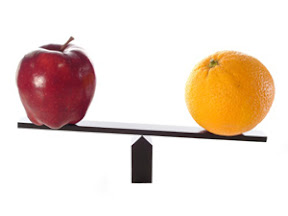
Comparing Apples to Oranges: All Books Are Not Equal

Earlier today on Twitter, I brought up a common theme in publishing that I dislike tremendously: comparing a “bestselling” novel to another book with only minimal similarities.  This has been evidenced by the constant “For fans of the Twilight saga…” or “For fans of the Stieg Larsson trilogy…” blurbs I’ve seen all over book covers.

I’m not going to pretend that I don’t understand the author/publisher’s motives with these comparisons. Linking a bestseller to an unknown book/author can be quite the sales-generator. 

Conversely, what about that debut author, whose work has been compared to a bestselling author?  They have taken the time to write a novel that they feel is unique, novel, deserving of it’s own attention & fame. Once they are compared to a bestselling author, are they forever hidden under this fame?

So, what say you? What is your opinion of this frequent and unequal comparison of one book to another?  Do you think that, in the long run, it benefits the “unknown” author, or is it more of a hindrance to their success?

I’d love to get all viewpoints on this one: authors, publicists, readers, bloggers. If you have a book that has been unjustly compared to another, speak up!  Are you happy for the attention (and sales) or would you like to bask in your own glory? If you’ve read an “unknown” book compared to popular author, I want to hear from you as well!
Tags:
This entry was posted in Bookish Chatter. Bookmark the permalink.

22 Responses to Comparing Apples to Oranges: All Books Are Not Equal

  1. Becky
    Twitter:
    says:

    I don’t think I’d consider it a hindrance. The problem comes when the books being compared really aren’t comparable — that’s not useful and would, in my mind, make it harder for a reader to trust the comparisons to come. But if they are a good “readers who liked… will like/should try…” comparison, I think they’re great. It means that you can introduce readers to a new-to-them author by using one they’re familiar with.

  2. MelissaW
    Twitter:
    says:

    I think the comparison brings a lot of assumption to a new author. If an author is touted as the “next David Foster Wallace” or “next James Patterson” we expect to have our socks blown off if the referenced author is someone we like OR we expect the book to stink to high heaven if it’s someone we loathe (I have actually passed on a book recommended to me as “the successor to A CONFEDERACY OF DUNCES” because that is a book I really wish I could scrub out of my brain).

    The only problem is that, as humans, we expect comparisons! (o.O) So it’s a double-edged sword – the comparison/recommendation brings unnecessary preconceptions to a new author but we may not hear of the new author/book without the recommendaton.

  3. Nishita
    Twitter:
    says:

    I don’t feel too strongly about it. As long as the comparison is logical (for exampe,Twilight and hmmm Vampire Diaries), I don’t see a problem with it.

  4. Pam
    Twitter:
    says:

    I don’t feel strongly about it but there is one part of it that annoys me. About three months ago I was in a grocery store line and I was checking out the books and saw a new book from Dan Brown. Eye rolling all the way I picked it up and it took me quite a bit to realize the book wasn’t by Dan Brown it was blurbed by Dan Brown and the author’s name was tiny tiny on the side cover with Dan Brown’s name being the only name on the cover. I found this to be misleading.

  5. Stephanie
    Twitter:
    says:

    I have to admit that I’ve bought books before just because of author blurbs or comparisons, which makes me the perfect consumer (and a sucker)!

  6. TERESA says:

    Maybe I’m a tad cynical but if I see that an already established and extremely successful author has endorsed the book on the front cover I often wonder if they’ve actually read the book or have had their “mutual” publisher suggest/twist their arms…

  7. Jennifer says:

    I have learned long ago to ignore any endorsement blurbs, especially when they are comparing two authors (I am not a huge fan of comparing authors to begin with). One this sets the reader up (either positively or negatively). What if the best selling book being compared was one I did not care for, does it mean I should not read the one it is being compared with? No. I imagine there is a reason for these blurbs, but I find them pointless and often a discredit to a book.

  8. Florinda
    Twitter:
    says:

    I have mixed feelings about it. Occasionally those comparisons – “fans of X will love Y” – have tipped the scale in favor of my trying a new-to-me book or author, so I’m open to them. And sometimes they’ve been just as effective at keeping me away :-) . But I’ve also had the experience of reading both the authors or books being compared and finding no real basis for the comparison, and that’s made me take the whole process less seriously – less recommendation, more marketing ploy.

  9. Beth F
    Twitter:
    says:

    Well, I generally ignore the types of comparisons you are talking about. I am more likely to be swayed by the book summary, a review, or a personal recommendation.

  10. If the comparisons are going to come from anyone, I’d rather they be from readers than the marketing department. That, to me, is a more genuine assessment of whether the book really does remind someone of another.

    But blurbs, as others have pointed out, tend to serve the same function and in a less direct way. Those never influence my decision to buy a book, but they do encourage me to pick it up and check it out!

  11. BridgetH says:

    From a publicist’s perspective, we do this intentionally because we’re trying to target an audience that we think will enjoy the book. No publisher would ever deal with a book *exclusively* because it fits into a targeted demographic–its just one of many reasons why the book might be worth picking up. Marketing and publicity are actually very different departments so I can’t really speak to the marketing motives.

    I’ve never worked with a debut author who specifically asked not to compare his or her work to another already-published author, but if they asked we would consider why it might be harmful to make this comparison because it is very very important.

    And for people who say they don’t buy a book because of this angle–that’s ok because our intention is for you to pick it up and take a closer look. It’s you, the reader’s consideration that propels our comparative suggestion. If this idea didn’t work so well, we wouldn’t use it.

    But as a reader, even before I worked in publishing, I absolutely paid attention to blurbs and reviews. Because the core of the idea is ‘why wouldn’t I want to read more of something I liked so much?’

  12. Michelle says:

    I’m with Candace, I barely even recognize when a comparison is made. I look at the blurb to see if I’ll like the story, I don’t care what other book it’s like. :) Having said that, it can be frustrating for those that are a fan of a particular author who then take on another book because of a blurb/comparison and it fails to live up to expectations.

  13. I love this question! As a reader, I think those comparisons are pretty silly. I buy a debut author’s book because it’s in the right place at the bookstore (that placement is so key) or because a friend or blogger recommended it. To be honest, I think blurbs are kind of stupid and I don’t pay attention to them. There’s no way someone wrote the next Twilight, otherwise it would be called Twilight. As a writer, I know those comparisons can mean a lot of sales. But as I try to find an agent and publisher for my book, I’d never pitch my book by comparing it to these big names. Imagine if I said: “I wrote the next Harry Potter!”? It sounds seriously amateurish and publishing professionals would sneer at . I’m not sure why the industry is ‘above’ it when it comes to a situation like that, but then thinks it’s okay for the buying public. All of this being said, would I mind if my book made it on the shelf and it said, “The nexy Harry Potter”. Hell no. I’d just be laughing all the way to the bank.

  14. Jessica says:

    The books that tend to do this are usually genre fiction and quite honestly alot of ppl that read those kinds of books do want to read very similar stuff. I have a co-worker that just reads vampire books and my dad pretty much just reads crime and Dan Brown so I think the comparisons helps them.

  15. Lulu
    Twitter:
    says:

    I saw Steve Berry, who writes historical thrillers, speak on this very topic at the Athens (GA) Library near my alma mater. He’d been writing these thrillers since before Da Vinci Code came out, and was struggling to sell books until his publisher was able to bootstrap his new releases onto Brown’s. Now I see his books everywhere, and I imagine two things – he’s thrilled to be recognized in his own right, and either appreciative or feeling bittersweet that Brown, not he, led to his own popularity.

    I agree with Jessica – it can be helpful to genre readers. As a mystery reader, particularly Swedish mysteries, I trust a review on the front that says “like the modern master, Henning Mankell” and the like (sorry, Steig). There’s a danger of pigeonholing…but anything that gets people to buy more books is fine by me :)

  16. Jen Forbus
    Twitter:
    says:

    I’m also one who doesn’t pay attention to blurbs or comparisons. I try to read each book as its own entity and see the style of the writer. Sometimes I can feel similarities to other authors I’ve read, but I make those conclusions myself. I don’t rely on publicists to make them for me.

    Then when people come to me and say, “I liked [so and so], who else can I read like that?” I try to be as honest and forthcoming about who would be comparable. I also try to explain why I think they are comparable…subject matter, writing style, etc.

  17. Jael
    Twitter:
    says:

    As a debut author, this is definitely a double-edged sword for me — on one hand, people don’t know what to expect from my book, so if we can give them a sense of what’s in there, that’s helpful. But on the other hand, you never know what associations people have with particular authors or books, so it can be dangerous. The “Readers of X might enjoy Y” construction seems most useful. (And you can’t control it, in any case — one of my major reviews concluded with “will appeal to fans of Sarah Addison Allen.”)

    If you’re just using a surface-level similarity to piggyback on a super-successful book, though — “this circus book is the next Water For Elephants!” or “this book set in the South is the next The Help!” — I do find those irritating.

  18. As a librarian, I use these kinds of comparisons to cue readers to something they might enjoy. It can be surprisingly difficult to get some readers to step beyond known authors; comparing someone to an author they know can help. Obviously it’s distasteful when it looks to me like it’s being done as a purely commercial, and non-substantive, ploy. But I find it quite useful in recommending books, too, and my goals are not related to profit margins. :) One reader’s experience is rarely identical to another’s, so I think it’s good to remind a reader that we won’t always agree – but basically what you’re talking about is a read-alike, right? That’s a basic way to recommend books. Author A has a lot in common with B; if you like B, you might consider trying A. Seems very reasonable to me – when done responsibly. I guess that’s the key.

  19. Trisha
    Twitter:
    says:

    I rarely find books this way; although I have been tempted recently when I’m looking for a fresh read but want something specific. If comparisons are relevant, I think it’s an interesting way to find a book. If, however, the comparison is rather a stretch, it’s a marketing ploy that annoys me. I hope that makes sense!

  20. Pingback: Bookish links for Saturday, March 19, 2011 | BOOKS AND MOVIES

  21. Pingback: Book Review – You Know When the Men Are Gone by Siobhan Fallon | Hey Lady! Whatcha Readin'?

  22. Pingback: Welcome BEA Attendees! | Jenn's Bookshelves

Leave a Reply

Your email address will not be published. Required fields are marked *

*

You may use these HTML tags and attributes: <a href="" title=""> <abbr title=""> <acronym title=""> <b> <blockquote cite=""> <cite> <code> <del datetime=""> <em> <i> <q cite=""> <strike> <strong>